Columnsコラム · Oct 18, 20262026/10/18
Even PSA can’t tell: the 1988 Dragon Ball Carddass Goku comes in three versionsPSAも知らない。ドラゴンボールのカードダス第1弾「1988」には、3種類の悟空がいた
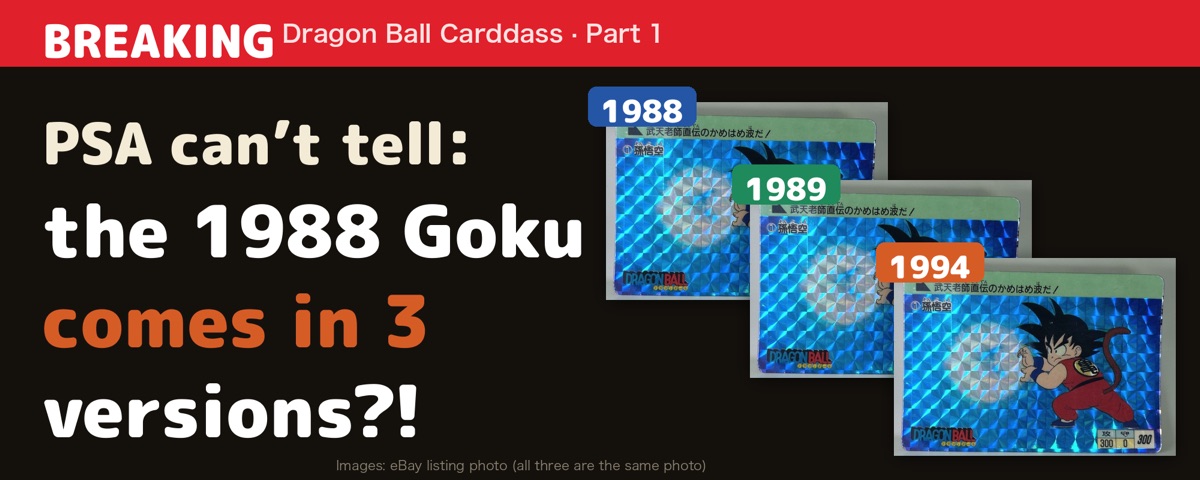
Hi, I'm No Rarity, a collector in Japan.
Dragon Ball Carddass, main series Part 1: 42 cards sold from vending machines at the end of 1988.
How much does card No.1, Son Goku, sell for on eBay in PSA? About $3,000 in PSA 3. About $10,000 in PSA 6.
That's PSA 3 — white corners, a card most people would call “played”. And it still sells for the price of a used car.
If you collect Carddass, you probably know that much. This post is about what comes next.
The 1988 Part 1 was supposed to exist in only one version. But a French collector published an article that turns that upside down: the 1988 Goku actually comes in three versions.
I once wrote about two different 1988 Gokus — Bandai's Carddass and Amada's PP Card (post on X). This is something else entirely: the Bandai Carddass 1988 Goku itself comes in three versions.
Nobody doubted the “1988” on the back
Carddass backs carry the year of release. Part 1 says “BANDAI 1988 MADE IN JAPAN”. So if the back says 1988, it's the 1988 Part 1 — everyone assumes that. So did I.
The article appeared on Adali.fr, a French site for Carddass collectors, written by a collector named Bob (“The mysteries of Dragon Ball Carddass Part 1”). His point, in one line:
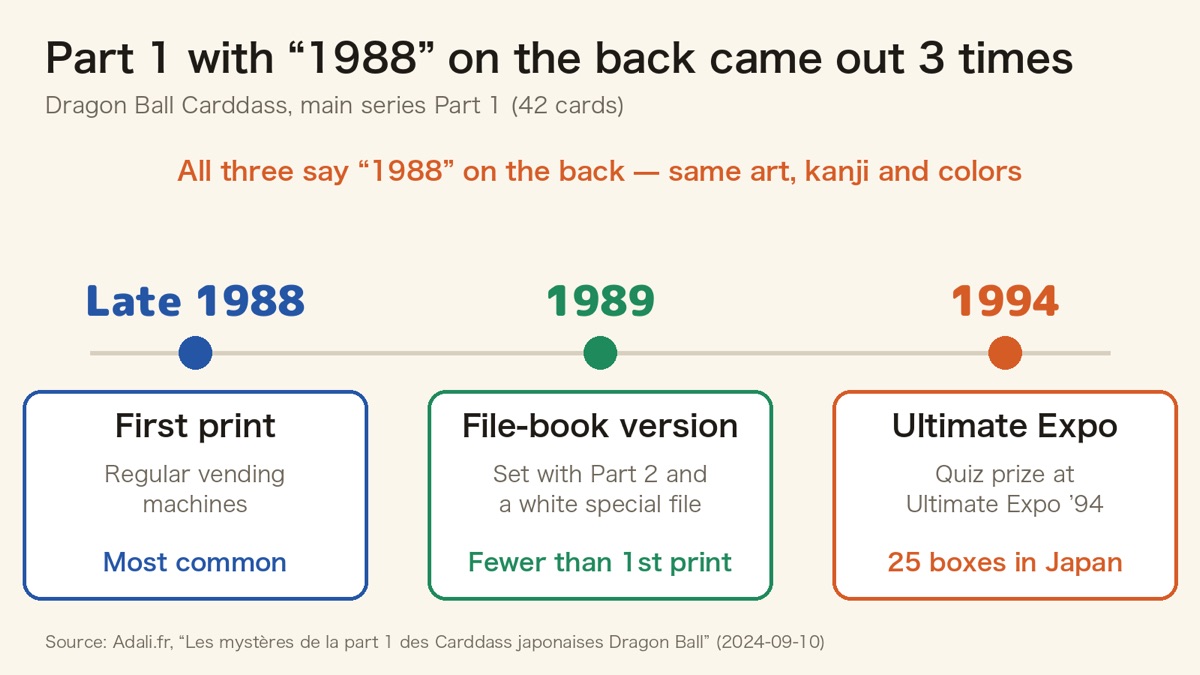
Part 1 with “1988” on the back was issued three times between 1988 and 1994.
The same “1988”, three times
Think of a book whose copyright page says “First edition, 1988” — but which was actually reprinted in 1989 and again in 1994 with the same page unchanged.
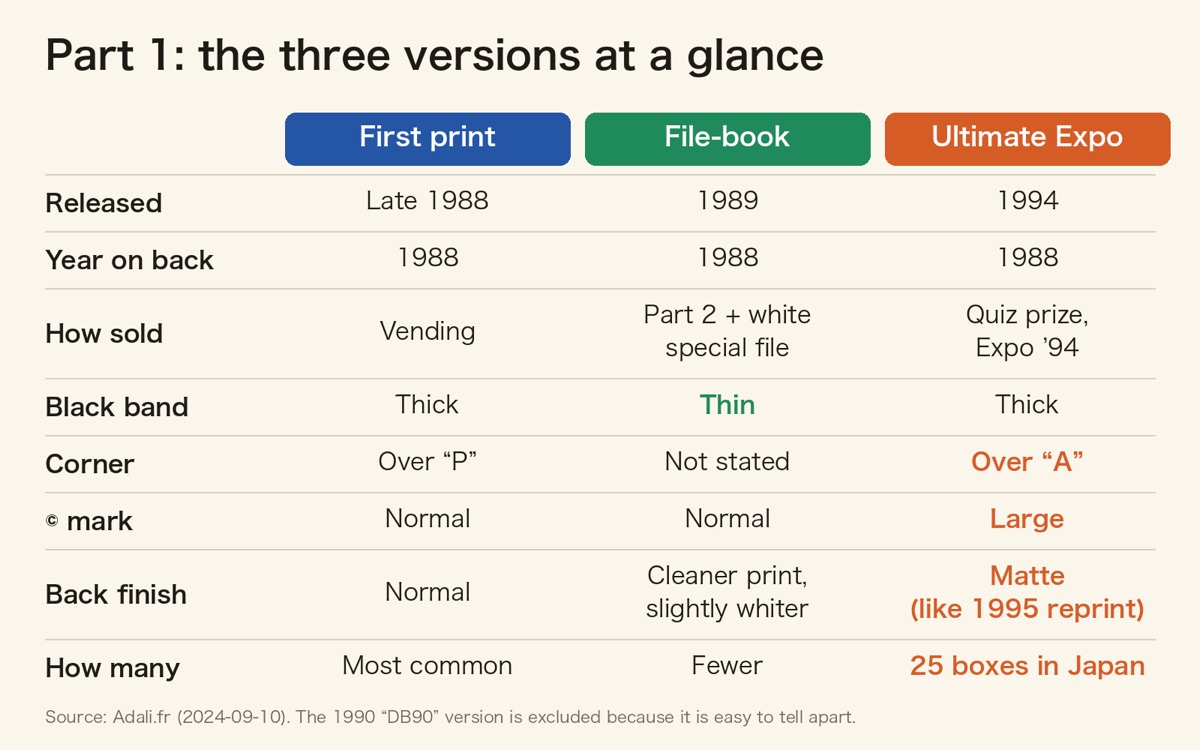
- The 1988 first print: sold from vending machines, by far the most common.
- The 1989 file-book version: included in a set with Part 2 and a white special binder (“Special File Book”). Released in 1989, yet the back still says 1988.
- The 1994 Ultimate Expo version: the star of this story, also called the “ingot version” after the shape of the prize box.
1994: a quiz prize
In autumn 1994, Weekly Shōnen Jump held the “Jump Character Carddass Ultimate Expo” (Kyūkyokuhaku). It toured five cities — Tokyo, Sapporo, Osaka, Nagoya and Fukuoka — for five days each. Entry was by lottery using coupons from Jump issues 41 and 42 of 1994, with 1,500 people per city.
At the venue there was a 50-question quiz: 45 questions answered at home in advance, the last 5 at the venue within 30 minutes. Only the single top scorer of each day won the prize. This one:
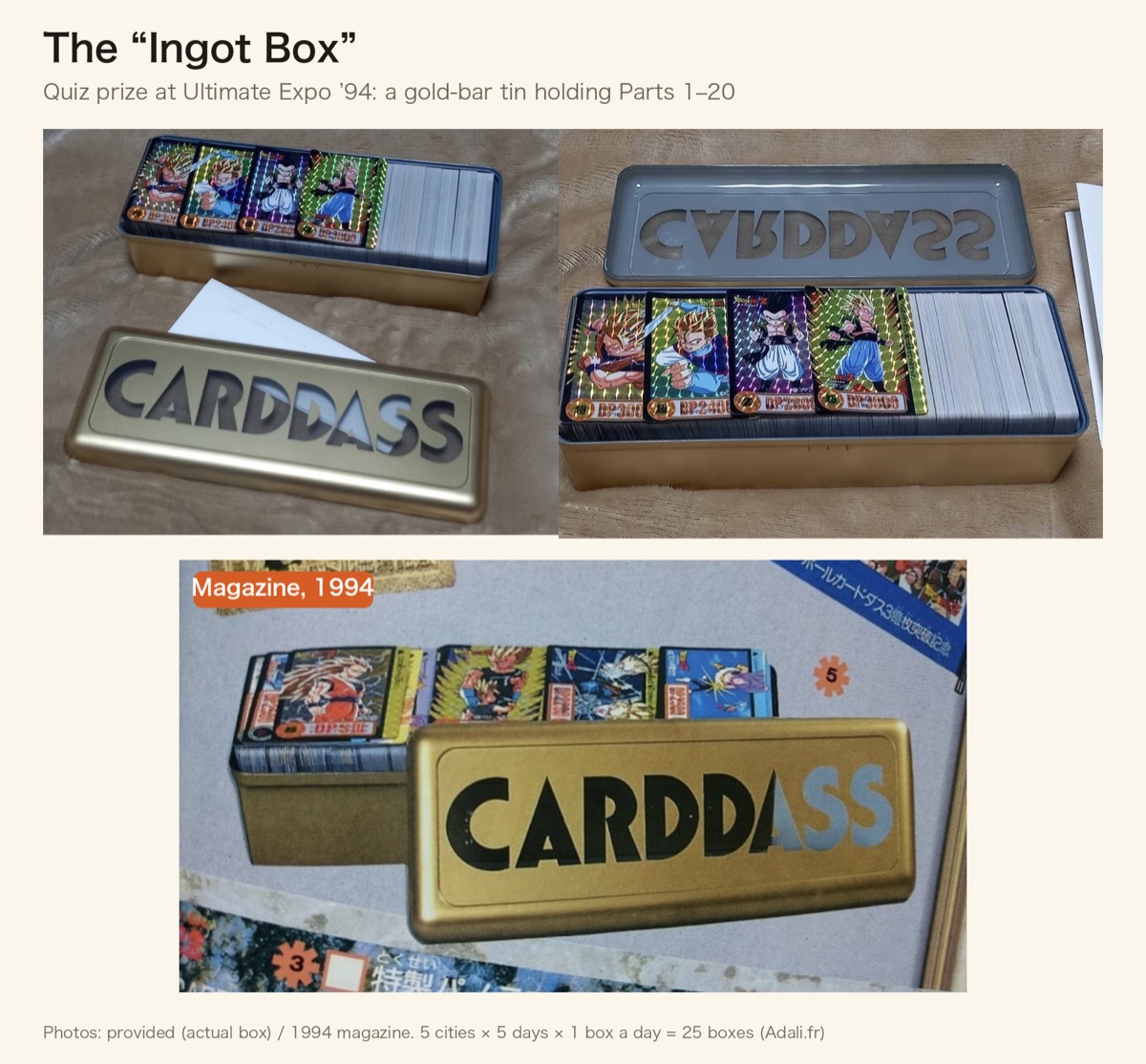
The “Ingot Box”, a tin shaped like a gold bar, holding Dragon Ball Carddass Parts 1 to 20. One box a day: five cities × five days = 25 boxes in Japan (an event with the same rules was also held in Hong Kong that year).
So if each box held one set of Part 1, the Ultimate Expo version exists in only about 25 copies per card in Japan. And the back still says “1988”.
Look at the bottom right of the back
The front art, the kanji on the back and the colors are identical across all three. The differences are in the small details of the back. Here are the actual cards from the original article:
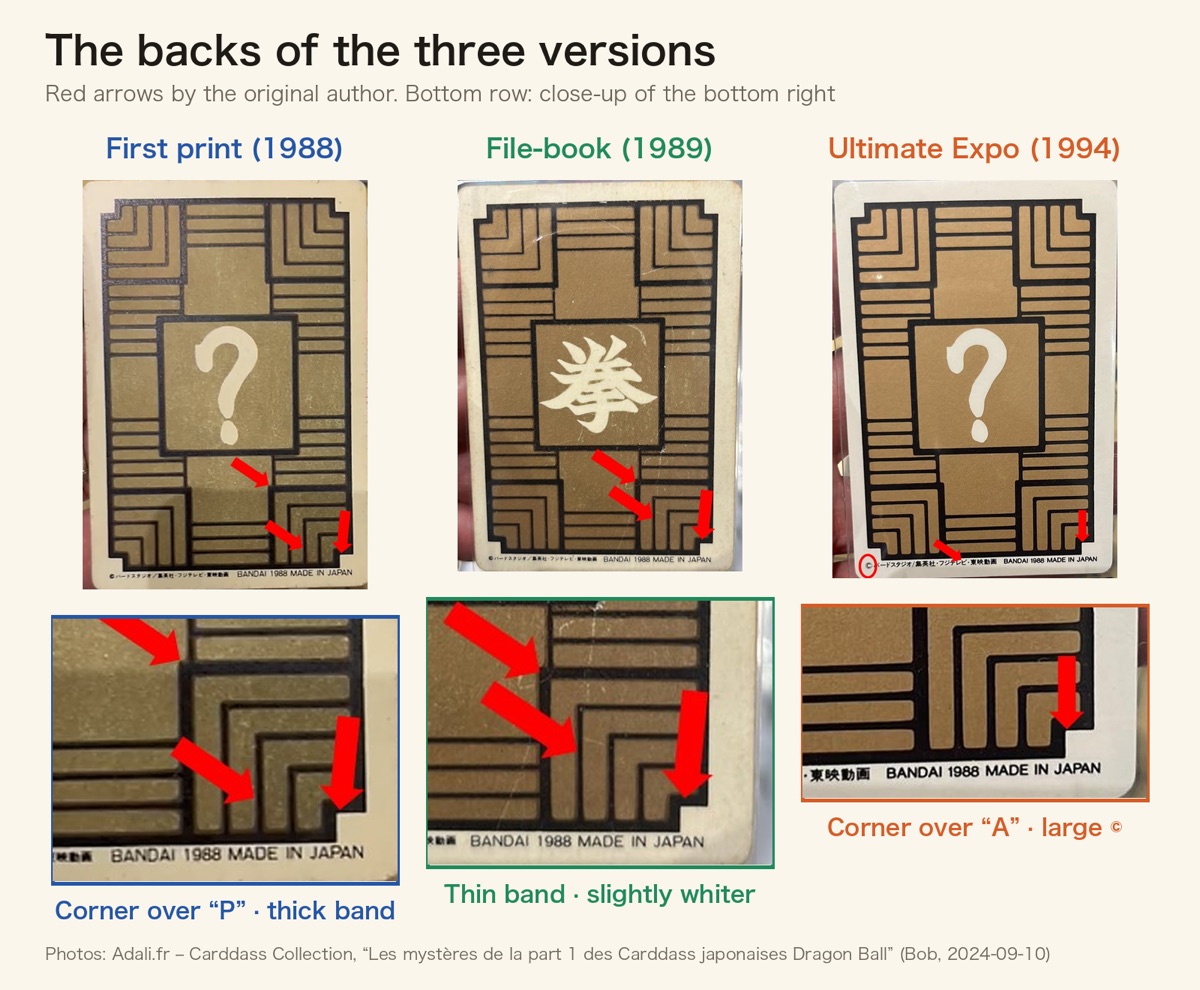
From left: first print, file-book version, Ultimate Expo version. The red arrows were added by Bob. The kanji in the middle (拳) changes by card type and has nothing to do with the version. Look at the bottom-right corner in the close-ups.
- First print: thick black band; the corner sits over the “P” of “JAPAN”.
- File-book version: a clearly thinner band, and the whole back looks slightly whiter.
- Ultimate Expo version: the corner sits over the “A”. The red circle at bottom left marks the © symbol, printed larger than on the other versions.
But PSA doesn't tell them apart
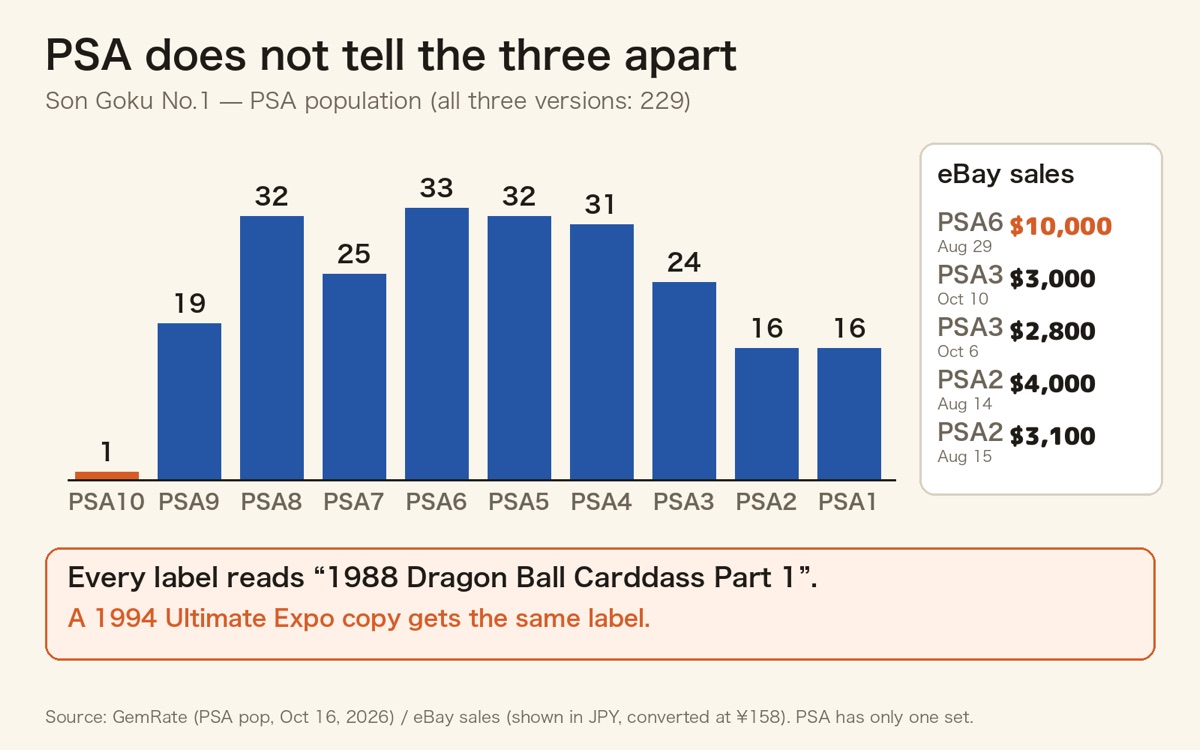
PSA counts every Son Goku No.1 in one set: “1988 Dragon Ball Carddass Part 1”. First print, file-book or Ultimate Expo — the label is the same.
Looking through recent PSA sales of Part 1 Goku, I found none sold as “Ultimate Expo” or “ingot” versions. Even if one of the 25 copies made in 1994 is in there, it gets the same label and the same price.
Live from this site: Son Goku (Kid) No.1 — latest PSA salesこのサイトのデータ(毎日更新):孫悟空(幼少期) No.1 の直近のPSA成約
- PSA 3 — $2,380 ≈ ¥376,040¥376,040 約$2,380 Oct 11, 20262026/10/11
- PSA 2 — $3,100 ≈ ¥489,800¥489,800 約$3,100 Aug 16, 20262026/8/16
- PSA 2 — $1,700 ≈ ¥268,600¥268,600 約$1,700 Aug 3, 20262026/8/3
- PSA 10 — $21,000 ≈ ¥3,318,000¥3,318,000 約$21,000 Jun 22, 20262026/6/22
- PSA 4 — $1,325 ≈ ¥209,350¥209,350 約$1,325 May 24, 20262026/5/24
- PSA 6 — $3,199 ≈ ¥505,442¥505,442 約$3,199 Apr 29, 20262026/4/29
PSA population: 229 graded, 1 PSA 10 (all three versions combined).PSAの鑑定数:229枚、うちPSA10は1枚(3つの版の合計)。
Some people have noticed
Search eBay for “Ultimate Expo” and you find:
- PSA 8 King Piccolo No.3, “1988 Ultimate Expo”: about $2,600 (Sep 25)
- PSA 8 King Piccolo No.4, “1988 Ultimate Expo”: about $2,600 (Sep 25)
- PSA 8 King Piccolo No.3, “Ultimate Expo”: about $2,370 (Sep 28)
The PSA labels still say 1988, but sellers put “Ultimate Expo” in the title and they sold at around $2,500. For comparison, the 1995 reprint is graded separately by PSA as “1995 REEDITION”, and the same King Piccolo in PSA 8 sold for about $110.
On October 16, Japanese Dragon Ball collector Pekin posted about exactly this (post on X), noting that few grading companies grade with this difference in mind.
- PSA labels don't separate the three versions.
- Most listings don't either.
- But a few specialist collectors and sellers know, and sell them as “Ultimate Expo”.
Honest caveats
- How to tell the versions apart comes from Bob's article on Adali.fr, not from any official Bandai statement.
- The original article doesn't state the corner position for the file-book version.
- “25 boxes” comes from another Adali.fr article (a report on Ultimate Expo ’94). How many sets of Part 1 each box held is not confirmed.
- I haven't yet compared “Ultimate Expo” sales with regular 1988 copies of the same card and grade.
- Inside a PSA case, reflections can make fine details on the back hard to see.
- I haven't held an Ultimate Expo copy myself yet.
This post lists what I found. It is not investment advice.
What I'm going to do
I'll zoom in on the back photos of every PSA-graded Part 1 listed on eBay, one by one: is the corner over the “P” or the “A”? For the same price, I might find one of the 25 copies made six years later. I can't not look.
If you own a Part 1 card, check the bottom right of the back.
こんにちは、旧裏マークなしです。
ドラゴンボールのカードダス、本弾の第1弾。1988年の年末に自販機で売られた、全42種のシリーズです。
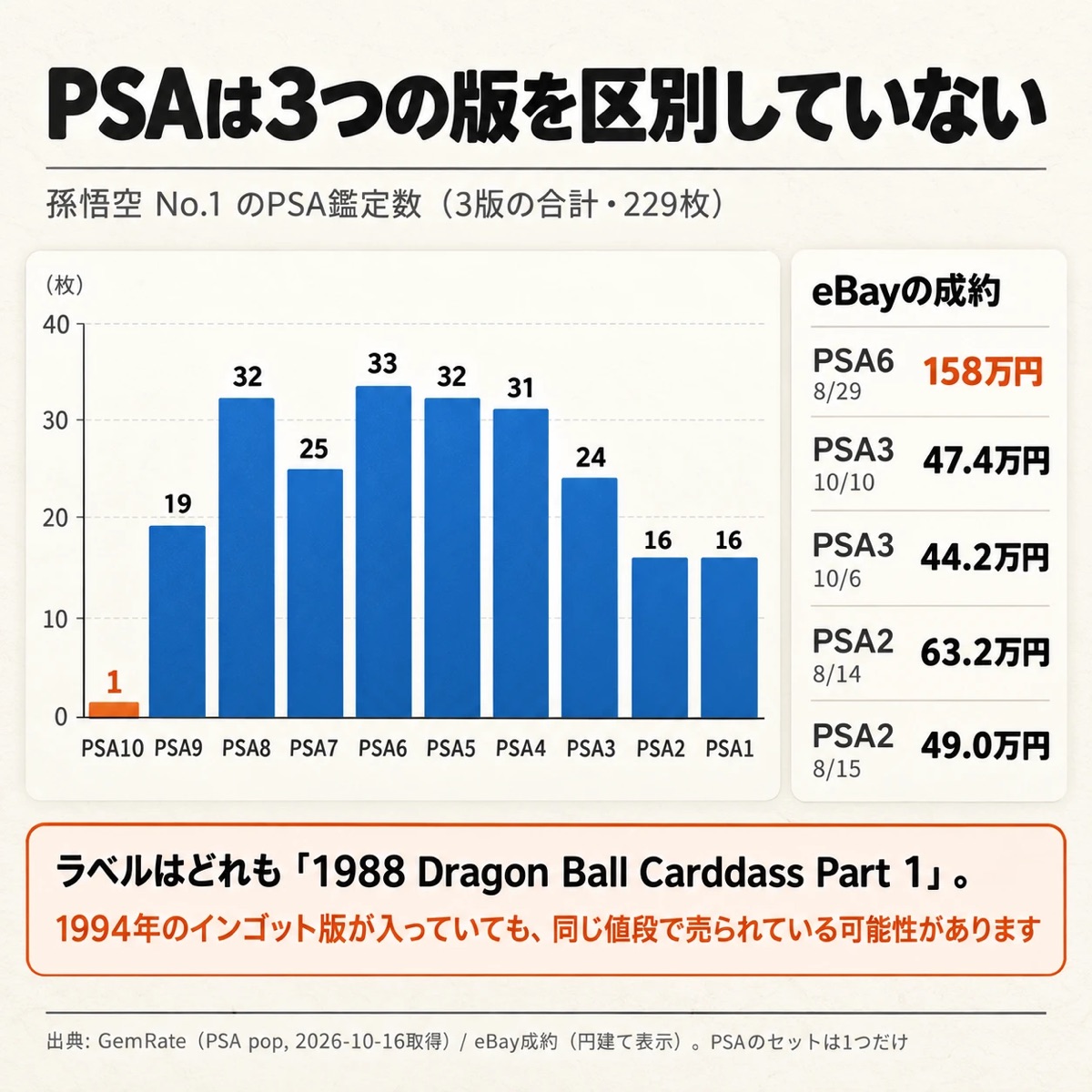
その1枚目、孫悟空(No.1)のPSA鑑定品が、いまeBayでいくらで売れているか。PSA3で約47万円。PSA6だと約158万円です。
PSA3ですよ。角も白くなっていて、ふつうなら「傷あり」と呼ばれる状態です。それでも、中古の軽自動車が買えそうな値段がついています。
ここまでは、カードダスを集めている人なら知っている話だと思います。今回お話ししたいのは、その先です。
1988年の第1弾は、1種類しかないはずでした。ところが、フランスのカードコレクターが、それをひっくり返す記事を投稿していました。「1988年の孫悟空は、実は3種類ある」という主張です。
以前、1988年の悟空には、バンダイのカードダスの悟空と、アマダのPPカードの悟空の2種類がある、という話をしました(Xのポスト)。今回はそれとはまったく違います。バンダイのカードダス、1988年の悟空そのものが、実は3種類ある。そういう内容です。
裏の「1988」を、誰も疑わなかった
カードダスの裏には、発売の年が印刷されています。第1弾の裏は「BANDAI 1988 MADE IN JAPAN」。だから、裏に「1988」とあれば、それは1988年の第1弾。誰もがそう思っています。私もそう思っていました。
記事が載っていたのは、「Adali.fr」というフランスのコレクター向けサイトです。Bobさんというコレクターが「ドラゴンボール カードダス第1弾の謎」という記事を寄稿していました。彼の主張をまとめると、こうです。
裏に「1988」と書かれた第1弾は、1988年から1994年までの間に、3回出ている。
同じ「1988」が、3回
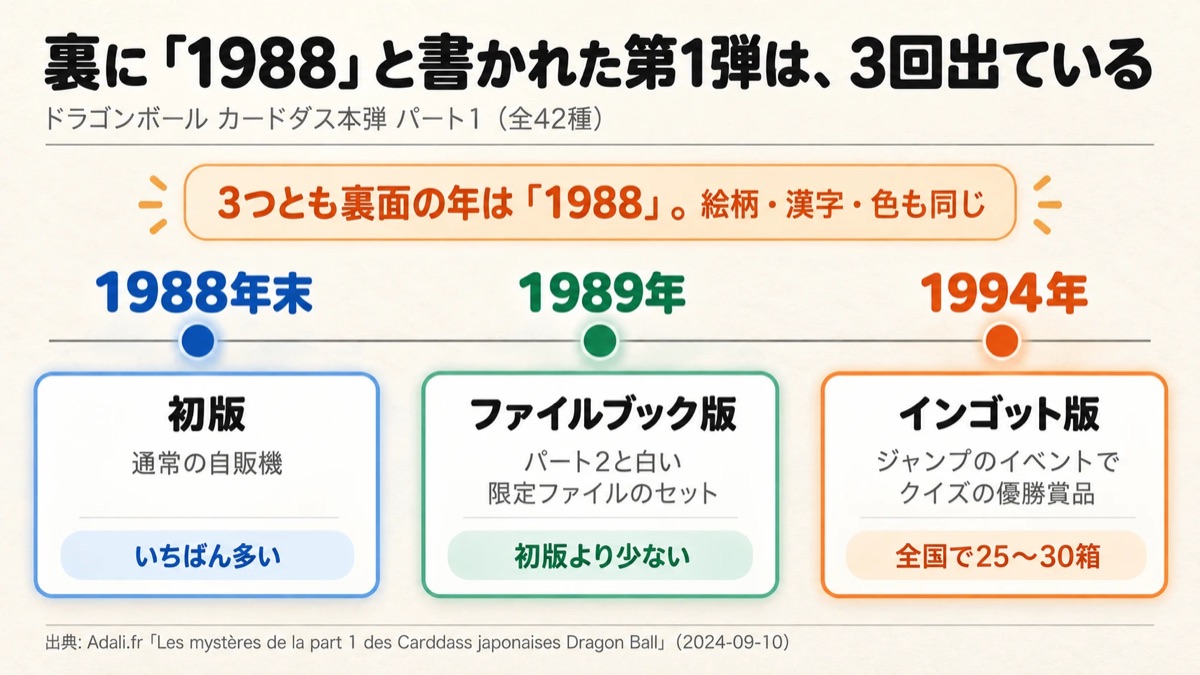
本でたとえると分かりやすいと思います。奥付に「1988年 初版第1刷」と書かれた本。それが実は、1989年にも、1994年にも、同じ奥付のまま刷られていた。そんな話です。
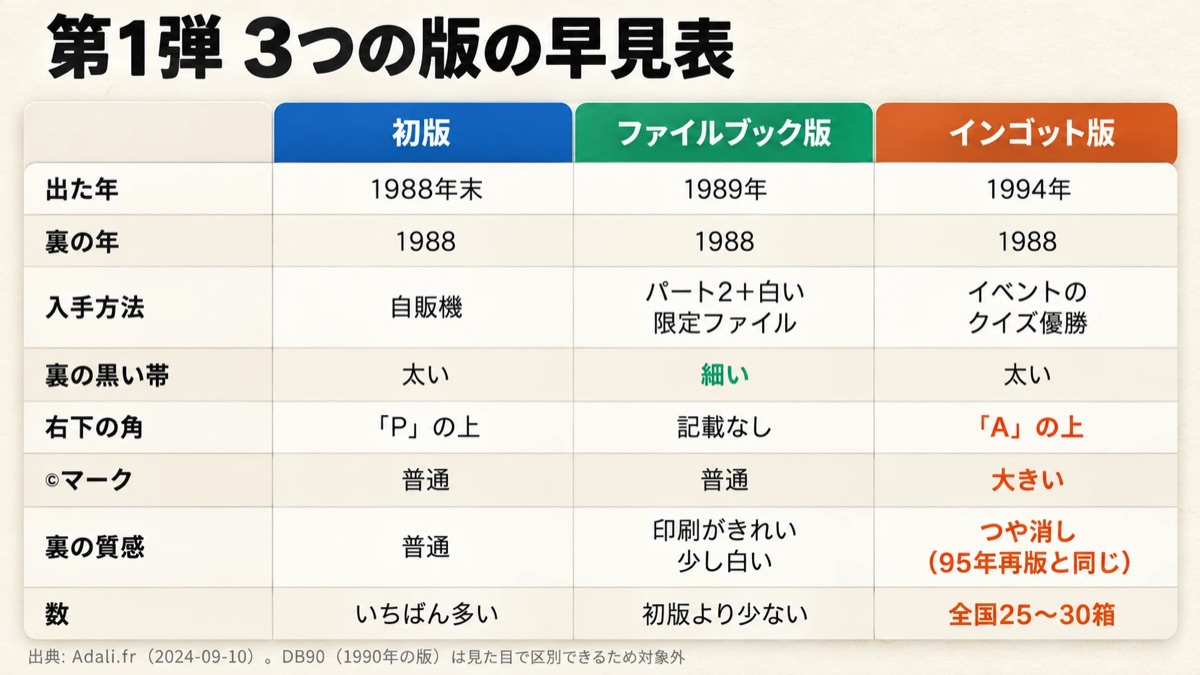
- 1988年の初版:自販機で売られた、いちばん数が多いもの
- 1989年のファイルブック版:第2弾と白い限定ファイル(「スペシャルファイルブック」)がセットになった商品に入っていました。発売は1989年なのに、裏の年は「1988」のままです
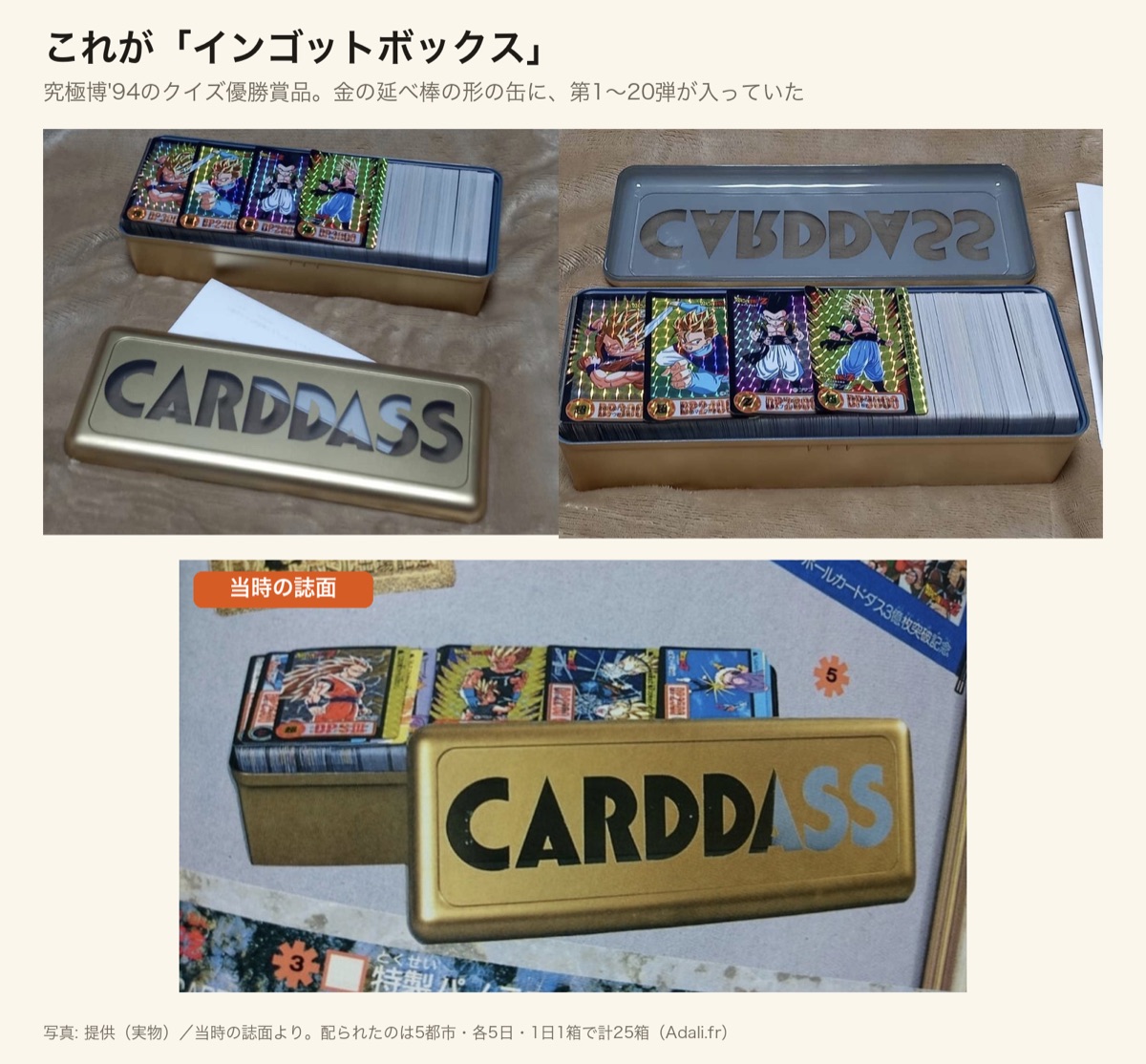
- 1994年の究極博版:今回の主役。賞品の箱の形から「インゴット版」とも呼ばれます
1994年、クイズの優勝賞品
1994年の秋、ジャンプが「ジャンプ キャラクターカードダス究極博」というイベントを開きました。東京・札幌・大阪・名古屋・福岡の5都市を、1都市5日ずつ回るイベントです。入れるのは、週刊少年ジャンプ(1994年41号・42号)の応募券で申し込んで、抽選に当たった人だけ。1都市1,500人でした。
その会場で行われたのが、50問のクイズです。45問は家で事前に解いて、残りの5問は会場で30分以内に答える。その日いちばん多く正解した1人だけが、賞品をもらえました。それが、これです。
金の延べ棒(インゴット)の形をした缶、「インゴットボックス」。中には、ドラゴンボールカードダスの第1弾から第20弾までが入っていました。1日1箱。5都市×5日で、日本で配られたのは25箱です(同じ年に香港でも、同じ条件で開かれています)。
つまり、この究極博版の第1弾は、1箱に1セットずつ入っていたとすれば、日本では1種類につき25枚しかないことになります。しかも、裏にはやっぱり「1988」と書いてあります。
見分けるのは、裏面の右下
表の絵柄も、裏の漢字も、色も、3つとも同じです。違いは、裏面の細かいところに出ています。元の記事に載っていた実物の写真を見てください。
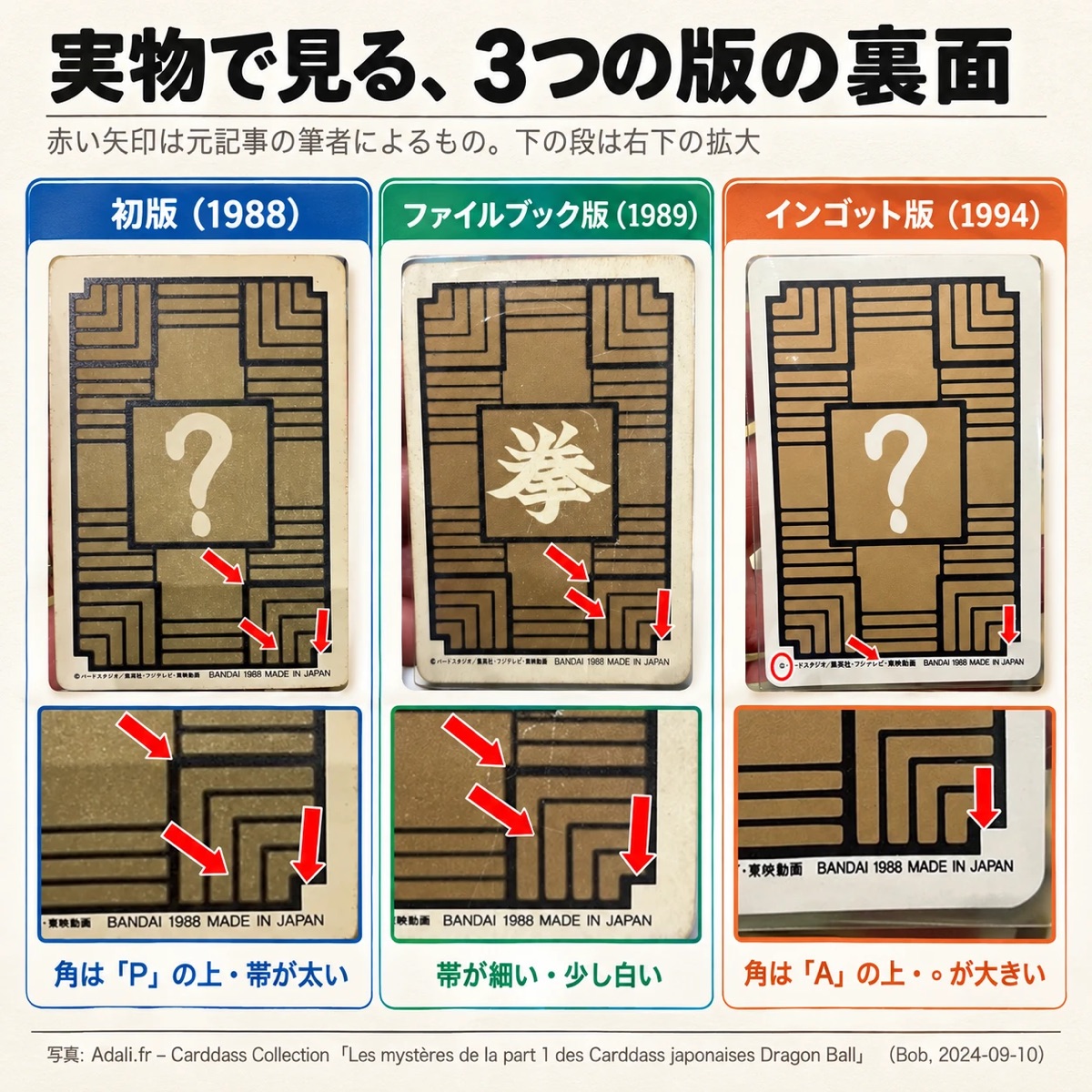
左から、初版、ファイルブック版、究極博版です。赤い矢印は、元の記事を書いたBobさんが付けたものです。真ん中の「拳」は、カードの種類によって変わる裏の漢字なので、版の違いとは関係ありません。見てほしいのは、下の段に拡大した右下の角です。
- 初版は、黒い帯が太く、角が「JAPAN」の「P」の上に来ています
- ファイルブック版は、帯が明らかに細く、全体が少し白っぽい
- 究極博版は、角が「A」の上に来ています。左下の赤い丸は©マークで、ほかの版より大きく印刷されています
ところが、PSAは区別していない
孫悟空(No.1)のPSA鑑定品は、PSAの中では1つのセット、「1988 Dragon Ball Carddass Part 1」として数えられています。初版も、ファイルブック版も、究極博版も、ラベルの上では同じです。
悟空(No.1)の第1弾のPSA鑑定品の成約を見ても、「究極博版」「インゴット版」と書いて売られていたものは、1件も見つかりませんでした。その中に、1994年に作られた「日本に25枚の版」が混じっていても、ラベルも値段も同じです。
Live from this site: Son Goku (Kid) No.1 — latest PSA salesこのサイトのデータ(毎日更新):孫悟空(幼少期) No.1 の直近のPSA成約
- PSA 3 — $2,380 ≈ ¥376,040¥376,040 約$2,380 Oct 11, 20262026/10/11
- PSA 2 — $3,100 ≈ ¥489,800¥489,800 約$3,100 Aug 16, 20262026/8/16
- PSA 2 — $1,700 ≈ ¥268,600¥268,600 約$1,700 Aug 3, 20262026/8/3
- PSA 10 — $21,000 ≈ ¥3,318,000¥3,318,000 約$21,000 Jun 22, 20262026/6/22
- PSA 4 — $1,325 ≈ ¥209,350¥209,350 約$1,325 May 24, 20262026/5/24
- PSA 6 — $3,199 ≈ ¥505,442¥505,442 約$3,199 Apr 29, 20262026/4/29
PSA population: 229 graded, 1 PSA 10 (all three versions combined).PSAの鑑定数:229枚、うちPSA10は1枚(3つの版の合計)。
ただし、気づいている人はいる
eBayで「Ultimate Expo」(究極博の英訳)と書いて売られているものを探すと、こうなります。
- PSA8 ピッコロ大魔王 No.3「1988 Ultimate Expo」:約41.1万円(9月25日)
- PSA8 ピッコロ大魔王 No.4「1988 Ultimate Expo」:約41.1万円(9月25日)
- PSA8 ピッコロ大魔王 No.3「Ultimate Expo」:約37.4万円(9月28日)
PSAのラベルは「1988」のまま。それでも、出品者がタイトルに「究極博版」と書いて、40万円前後で売れています。ちなみに、1995年の再販版はPSAでも「1995 REEDITION」と分けて鑑定されていて、同じピッコロ大魔王のPSA8が約1.8万円でした。
10月16日には、日本のドラゴンボールコレクターのペキンさんが、まさにこの話を投稿していました(Xのポスト)。ペキンさん自身も、「この違いをちゃんと認識して鑑定している会社は少ない」と書いています。
- PSAのラベルは、3つの版を区別していない
- 出品のほとんども、区別していない
- でも、一部の専門のコレクターと出品者は知っていて、「究極博版」として売っている
正直に書いておく注意点
- 3つの版の見分け方は、Adali.frのBobさんの記事にもとづいています。バンダイが公式に発表したものではありません
- ファイルブック版の右下の角の位置は、元の記事には書かれていません
- 「25箱」は、Adali.frの別記事(究極博'94のレポート)に書かれた数字です。1箱に第1弾が何セット入っていたかは、確認できていません
- eBayの「Ultimate Expo」の成約が、普通の1988年版よりどれだけ高いのかは、同じカード・同じグレードの比較がまだできていません
- PSAのケースに入ったままだと、光の反射で裏の細かい違いが見えにくいことがあります
- 私自身は、まだ究極博版の実物を手に取って確かめていません
この記事は分かったことを並べたもので、投資の助言ではありません。
私はどうするか
eBayに出ている第1弾のPSA鑑定品の裏面の写真を、1枚ずつ拡大して見ていくつもりです。角が「P」の上に来ているか、「A」の上に来ているか。同じ値段で、6年後に作られた25枚のうちの1枚が買えるかもしれない。そう思うと、見ないわけにはいきません。
手元に第1弾がある方は、ぜひ裏の右下を見てみてください。
Find these cards探すなら
自分で相場を調べたい方へ
私はAIを使い、日本市場と海外市場のコレクティブル調査を自動化しています。今回のようなカードの過去相場の検証や、出品作業をめっちゃ楽にしてくれます。Brainで販売しているので、ぜひご覧ください。
Sources出典
- The three versions and how to tell them apart: Adali.fr – Carddass Collection, “Les mystères de la part 1 des Carddass japonaises Dragon Ball” (Bob, Sep 10, 2024).
- Ultimate Expo ’94 and the Ingot Box: Adali.fr, “Weekly Jump Character Carddass Super Museum '94” (Apr 20, 2020).
- Ingot Box photos: provided photo and 1994 magazine pages.
- The Japanese name “Kyūkyokuhaku version”: posts by Pekin (@pekindaq), Oct 16, 2026.
- Number of cards (42): Kanzenshuu “Daizenshuu” database.
- PSA population: GemRate (Oct 16, 2026). Prices: eBay sales (Aug–Oct 2026, shown in JPY on eBay, converted at ¥158 = $1).
- Back photos: Adali.fr (taken by Bob). The table is drawn from the article's description.
- Sales: eBay, Fanatics Collect and Goldin, as collected by this site (How I select). Population: PSA, via GemRate.
- Images belong to their rights holders. If there is a problem, please contact me and I will respond promptly.
- 3つの版と見分け方:Adali.fr – Carddass Collection「Les mystères de la part 1 des Carddass japonaises Dragon Ball」(Bob、2024年9月10日)
- 究極博'94とインゴットボックス:Adali.fr「Weekly Jump Character Carddass Super Museum '94」(2020年4月20日)
- インゴットボックスの写真:提供写真と、当時の誌面
- 日本での呼び名「究極博版」:ペキンさん(@pekindaq)のポストと返信(2026年10月16日)
- 第1弾の枚数(42種):Kanzenshuu「Daizenshuu」データベース
- PSAの鑑定数:GemRate(2026年10月16日取得)/値段:eBayの成約(2026年8〜10月、eBayの円表示)
- 裏面の写真:Adali.fr(Bobさん撮影)。早見表は同記事の記述をもとに作図
- 成約:eBay・Fanatics Collect・Goldin(このサイトの集計。掲載の基準)/POP:PSA(GemRateの集計)
- 画像の権利は各権利者に帰属します。問題があればご連絡ください。すぐに対応します